
Learn when and why to use React's useCallback hook to optimize your application's performance. This comprehensive guide covers practical use cases, real-world examples, common pitfalls, and best practices to help you make informed decisions about memoizing functions in your React components.
The useCallback hook is one of React's performance optimization tools that helps prevent unnecessary re-renders by memoizing function references between renders. However, it's often misused or overused, leading to more complexity without real performance gains. This guide will help you understand exactly when useCallback is beneficial and when it's unnecessary.
useCallback is a React Hook that returns a memoized version of a callback function that only changes if one of its dependencies has changed. It caches a function definition between re-renders until its dependencies change.
Syntax:
1const memoizedCallback = useCallback(() => {
2   // Your function logic
3}, [dependencies] // Dependency array );If a function is only used within the component and not passed anywhere, memoizing adds unnecessary complexity.
1// DON'T do this
2function Counter() {
3  const [count, setCount] = useState(0);
4  const increment = useCallback(() => {
5    setCount(c => c + 1);
6  }, []); // Unnecessary!
7  return <button onClick={increment}>Count: {count}</button>;
8}
9
10// DO this instead
11function Counter() {
12  const [count, setCount] = useState(0);
13  const increment = () => {
14    setCount(c => c + 1);
15  };
16  return <button onClick={increment}>Count: {count}</button>;
17}If your callback has no dependencies or the component rarely re-renders, useCallback adds unnecessary overhead without providing any benefit.
Overusing useCallback on every function makes code harder to read and maintain without real performance gains.
Benefits of useCallback
Drawbacks and Trade-offs
1// Good
2const increment = useCallback(() => {
3  setCount(prev => prev + 1);
4}, []); // No dependencies needed
5
6// Less optimal
7const increment = useCallback(() => {
8  setCount(count + 1);
9}, [count]); // Recreates on every count changeReal-World Example: Form with Multiple Fields:
1function UserForm() {
2  const [formData, setFormData] = useState({ name: '', email: '', bio: '' });
3
4  // Memoize handlers to prevent Input re-renders
5  const handleNameChange = useCallback((e) => {
6    setFormData(prev => ({ ...prev, name: e.target.value }));
7  }, []);
8
9  const handleEmailChange = useCallback((e) => {
10    setFormData(prev => ({ ...prev, email: e.target.value }));
11  }, []);
12
13  const handleBioChange = useCallback((e) => {
14    setFormData(prev => ({ ...prev, bio: e.target.value }));
15  }, []);
16
17  return (
18    <form>
19      <MemoizedInput
20        value={formData.name}
21        onChange={handleNameChange}
22        placeholder="Name"
23      />
24
25      <MemoizedInput
26        value={formData.email}
27        onChange={handleEmailChange}
28        placeholder="Email"
29      />
30
31      <MemoizedTextarea
32        value={formData.bio}
33        onChange={handleBioChange}
34        placeholder="Bio"
35      />
36   </form>
37  );
38}
39
40const MemoizedInput = React.memo(({ value, onChange, placeholder }) => {
41  console.log(`Input ${placeholder} rendered`);
42
43  return
44      <input
45         value={value}
46         onChange={onChange}
47         placeholder={placeholder}
48      />;
49});Use useCallback when you genuinely need referential equality for functions—primarily when passing them to memoized child components or using them as dependencies in other hooks. Don't use it everywhere by default, as premature optimization can make code harder to maintain without delivering real performance benefits.
Remember: Profile first, optimize second. React is already quite fast, and most applications won't benefit from aggressive memoization. Use useCallback strategically, where it actually makes a measurable difference.
Continue exploring similar topics
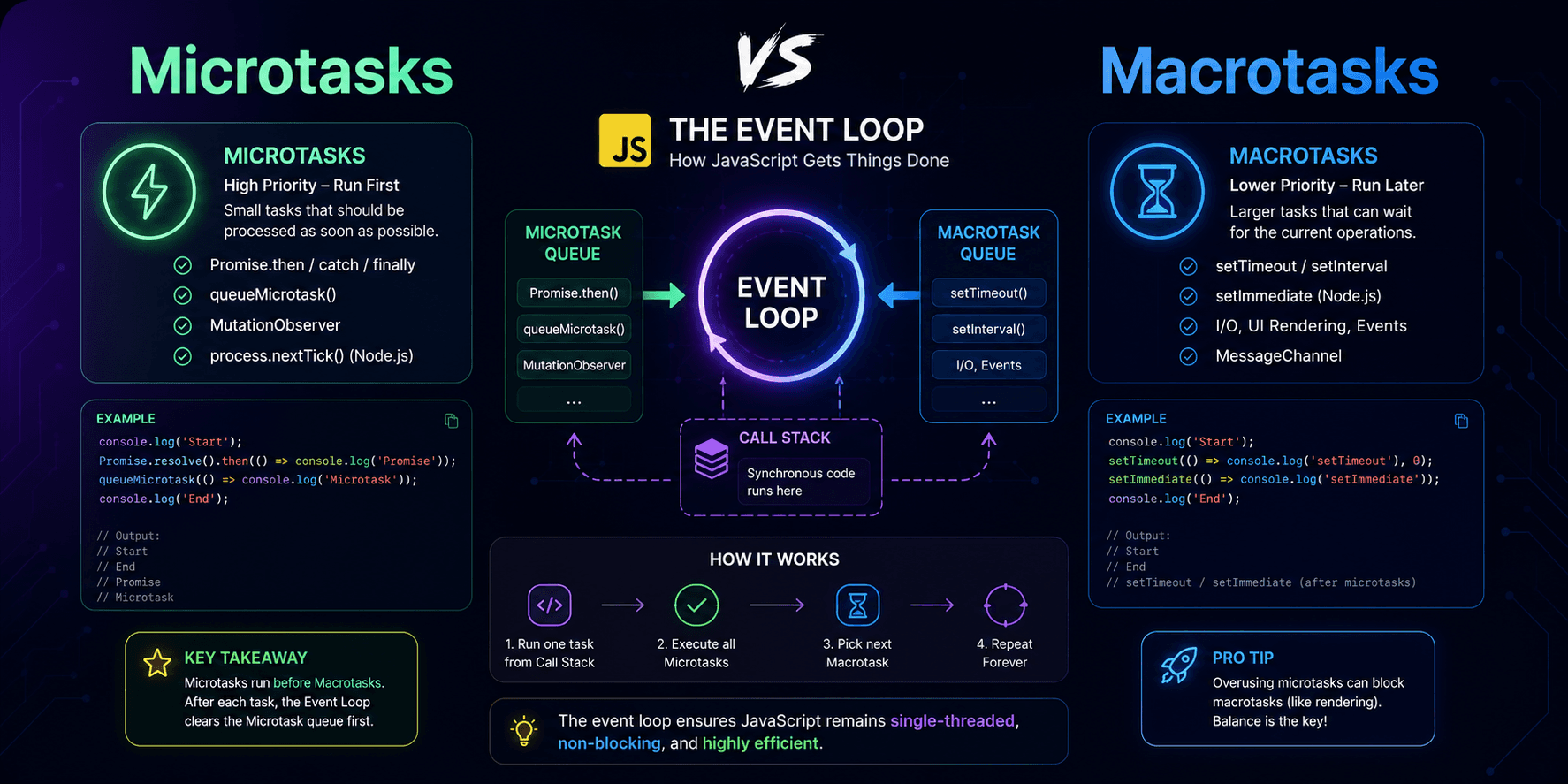
This article explains JavaScript microtasks and macrotasks in practical terms, showing why `Promise.then()` usually runs before `setTimeout(..., 0)` and how the event loop prioritizes different kinds of asynchronous work.

Animation Keys is a collection of essential UI animation terms that explain how motion can guide attention, provide feedback, show relationships between states, and improve the overall user experience in digital products.

Discover why the Next.js Link component outperforms traditional anchor tags for internal navigation. Learn the key differences, performance benefits, and practical implementation with real-world code examples to optimize your Next.js application.